












![The percussion section is known for being lively and yet also very locked in for the musical side of the band. Meyer, being a percussionist himself, has many tales of mischief from his years of participation. “After a season of marching band was over, [...] we would have a stick throwing competition at the end of the season and we would see who could chuck our sticks the farthest across the football field.”](https://bearingnews.org/wp-content/uploads/2026/05/JoMeyerPhoto1-1200x800.jpg)
RBHS senior Kelan Meyer’s passion for the last 10 years has been percussion. With his father, a jazz drummer that came before him, and his brother, a drummer that will follow, Meyer’s story exhibits the experience of being inspired and inspiring others.
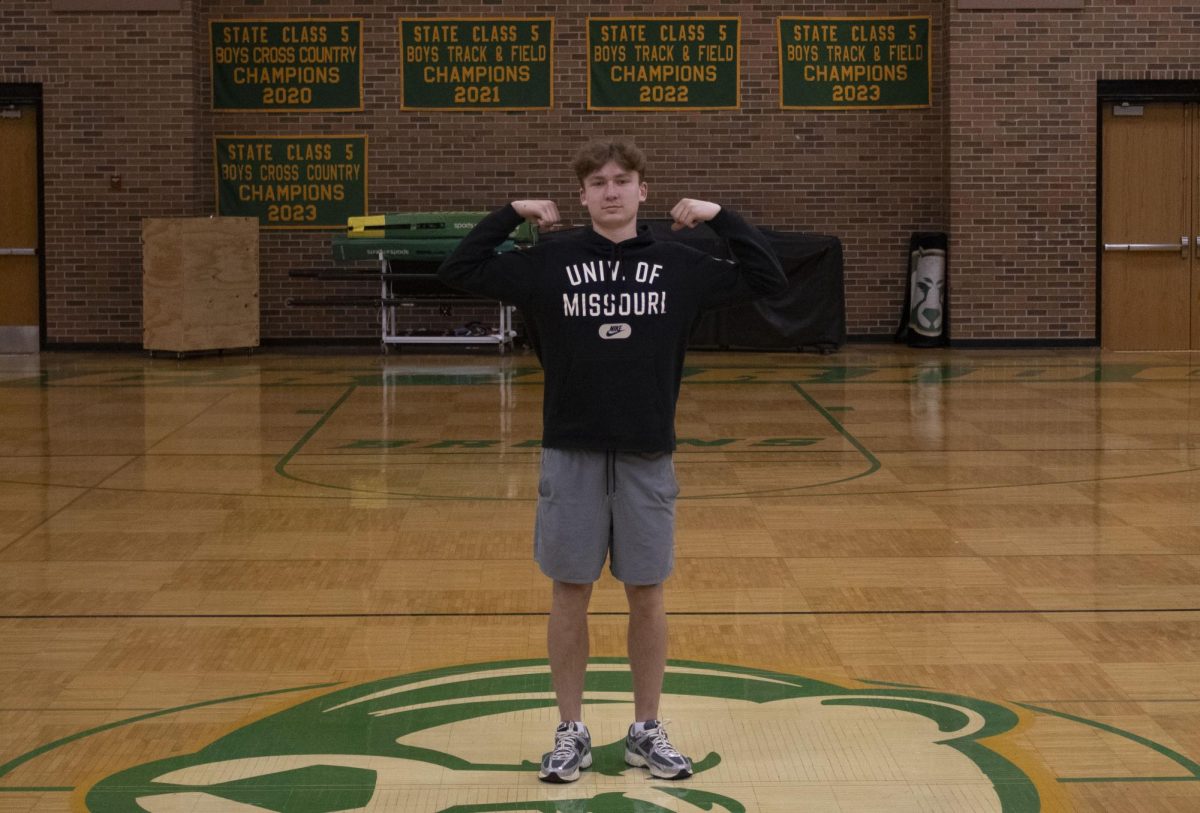
The next chapter in his life will take place at Missouri University. He plans to double major in performing arts and engineering. While he is passionate about both, he chose engineering because it will provide him with a more stable future. Regardless, Meyer plans to keep music as a large part of his life.
Q: “You’re a really good percussionist. Was there a point [where] you started and you were like, ‘This is what I [am] going to do,’ or has it always just been, ‘I want to be a musician. I want to be a percussionist?’”
A: “My dad was a drummer, a percussionist and a jazz musician, all throughout high school. So when they did the instrument night in 6th grade, I was like, ‘I’m going to drum.’ And then all throughout middle school, I was kind of just going along with it. But then in high school, [my freshman year], the seniors and the juniors really took it 10 steps up. They were doing stuff that I couldn’t even imagine was possible, and that really inspired me. So that’s why I decided right there that that’s what I wanted. I wanted to continue throughout high school and be just like them. That’s really what had the biggest influence on me and where I am now.”
Q: “I know your little brother, Hayden, is in the band program. Do you see yourself helping him find a balance?”
A: “Yeah, I didn’t push him to do anything. He joined band because he wanted to. He saw me and my dad do it, and he really wanted to do it, too. So I haven’t pushed him at all, but when he needs help, I always help him out. Like if he needs help sight reading music or he needs help with anything, […] I obviously am going to help him. It’s mainly just been him wanting to do the things I do. I haven’t had to do much, but when he needs it, I have helped him.”
Q: “Do you see yourself in him at all?”
A: “Oh yeah, 100%. My dad saw me in him, and then now I see me [in him]. It’s like, we all have that same drive and passion. It’s very clear.”
Q: “How much of what you do in band is to connect with the people versus to make music for the audience versus to make music [for] yourself?”
A: “When I play, I first make sure I’m doing everything accurately on the page. But after that, I kind of look around, see what everybody else is doing and try to make sure I fit in with them and make sure I’m connecting in the same way they are with the rest of the band. It’s just to make sure the ensembles are together, precise and connected [throughout the performance]. I think after that, it’s all about having fun, especially in Wind Ensemble or even Jazz. It’s [like] just having a jam [session] with one of my best friends in the back of the classroom. It’s really fun. That’s really where it [leads to] at the end of the day.”
Q: “Do you feel like in the band program, if you just dip your toes in, you can go to the deep end pretty quick? Do people fall in love with it, or is it harder [to get into it]?”
A: “It’s a case-by-case basis. For me, it was, like you said, I kind of dipped my toes in and I was like, ‘Do I want to do this?’ And then when I did, I was like, ‘I’m dedicated to this.’ So in my experience, yes, it is really easy to fall in love with it, but some people they’ll try Marching Band and that’ll be their thing and that’s what they want to do [or] they’ll do Wind Ensemble and that’ll be their one thing. They’ll [either] do that or maybe they’ll quit after two or three years and that’s fine. It’s just a person-by-person thing, and it [comes down to] the amount of drive and passion. That’s really [what determines it].”
Q: “Because you love this program and band so much, is it ever hard to watch people not like it as much or not put as much effort into it as you do?”
A: “I wouldn’t say I’m disappointed by anybody not choosing [to participate in band] because it’s whatever you want to do. I’m not going to say ‘You are terrible, you don’t practice.’ I’m not going to say that to anybody, obviously. It’s just based on how much they personally love music and want to keep practicing. So if I see somebody not putting [in] as much effort as me, I’m not going to be like, “Oh, you should be doing as much as I am,” because I’m insane. I do everything. I don’t expect anybody to do anything I do. I [do] advocate for people doing more, but I’m not going to forcefully push anyone to do anything [they don’t want to].”
Q: “[Marching and Jazz Band] have different vibes. [In] Jazz [there is communication] and then Marching Band, it’s very precise. How do you see that difference?”
A: “Jazz, like I was kind of saying, it’s [more so] a person-to-person connection in the band. People will throw out chord changes and then you [have] got to adapt to it, play the style and the way they want it during their solos. It’s a really intimate connection [from] player to player, and I really appreciate that about the rhythm section and the winds. Marching Band is a lot different. You’re just watching the drum major the entire time, playing precisely the same thing every single time. So they’re honestly polar opposites from each other because jazz is like, you can change the whole piece if you want. [I could] change the entire genre if [Mr. Patrick] Sullivan wanted me to. But yeah, [jazz is] not really as precise and the same thing every time. And then marching band is just like repeating the same thing over and over again. So they’re [definitely] different.”
Q: “What would you say the hardest thing is for you personally in the band program? What challenges do you see yourself having to overcome?”
A: “For me personally, I think the most challenging thing is just keeping up with all the things I do. I chose to do a lot my sophomore year, and it was actually too much. I did show choir, the Bruin Band and the Percussion Ensemble. [It was a lot]. […] I still do some of those things, but I had to take [a few steps] back after that because I realized there was no time to do anything else. There are some moments [when] I consider not doing as much and all that, which is fair because [there are many parts of the band world to be involved in]. But I think it’s just trying to balance your own life, music, social life, school and everything else. It’s a hard [balance], but you have to find it yourself. And once you do, it becomes kind of easy. That’s been my main hurdle I’ve had to get over.”
Q: “How long did it take you to find [the band vs. academics] balance? Was it a struggle your freshman year?”
A: “Yeah, it was definitely a struggle because freshman year especially, I didn’t really have any free time. They kind of loaded my schedule up with all core classes because I needed it. I basically didn’t practice at all then. But once I reached my sophomore year and got the AUT, I was able to start practicing a lot more at school and still [have] that time to study. These past two years, the academics haven’t been that hard, [and] I haven’t needed a lot of time to dedicate myself to academics. […] I’ve still had to [dedicate time to academics] obviously, but it hasn’t been as much as the previous years. I’ve been able to put a lot more time into my music [and] into practicing, and that’s kind of how it developed for me. It’s different for everybody, but it’s gotten easier to find both and do both.”
Q: “You mentioned district and state. Did you go out for that your freshman year? I know you’re in All-State now.”
A: “Yes, I didn’t originally want to do it, but I saw Breen Boone, AJ Tosh and Glenn Miller were all doing it, and I was like, ‘Should I do this?’ My mom […] , she was like, ‘You should just do it.’ And so I was like, ‘Okay, all right, fine. I’ll put in a little extra practice for it.’ And then I’ve done it every year since, and it’s been very fun. [… It’s been cool to see my growth], I was [first] in honorable mentions, then I was seventh chair, then fourth chair and then finally first chair. It’s been steady [upward progress] at districts and state too. So seeing that dedication and hard work put in definitely inspired me to come back […] every year because I got improved results. So it was really cool seeing that.”
Q: “Since you’re leaving high school, how much is music going to be a center in your life as it is now? Are you looking forward to making those new connections with people? Or is it a little bit scary? Will you have to start over?”
A: “Music has been my biggest passion for the past 10 years of my life. I’m going to continue to do it [at] Mizzou. […] I’m double majoring, [so] it’s going to be half my life at Mizzou. And that’s where I think I’ll connect with the most people, because we have [a] shared passion for music. And at [the] collegiate level, it’s even stronger, because it’s kind of the best of the best. And yeah, it will definitely [influence] my social life and everything else at Mizzou.”
Q: “You talked about band taking away from your study time [and] academics. In the future, how do you plan to balance it? Or is there just going to be two separate worlds?
A: “It’s going to be really rough because majoring in music is a big thing, especially [because] I’m doing music performance. So I’m going to have to be in the practice room for I think two to four hours every day. It’s going to be very difficult. But I’ve been kind of doing that every day anyway, just so I can [prepare] for that. But it’s going to be a big hurdle, and it’s probably going to be rough next year because I’m going to have to balance all my engineering classes and music classes. It may be too much, [but] I’m just going to have to see what happens. If it [doesn’t work out for me], I’m going to [consider that] I might have to minor in music or something [similar]. It might be too much, we’ll see.”
Q: “How did you find out about engineering and start thinking about it?”
A: “Well, I’m doing engineering, [so it’s related to] IT [and] computers. I’ve always had a love for computers. I built my own computer when I was [around] thirteen, […] and then I just built a new one recently with new parts. That’s always been a passion of mine. So I knew I wanted to do music, but music doesn’t have a straightforward job. […] It’s [an] unpredictable field. You have to do gigs, teach [or do something similar]. So I don’t really know what I’ll do with that, but I know with engineering, I could have a stable career path where I could get a job with IT. […] That’s why I really have to do both.”