






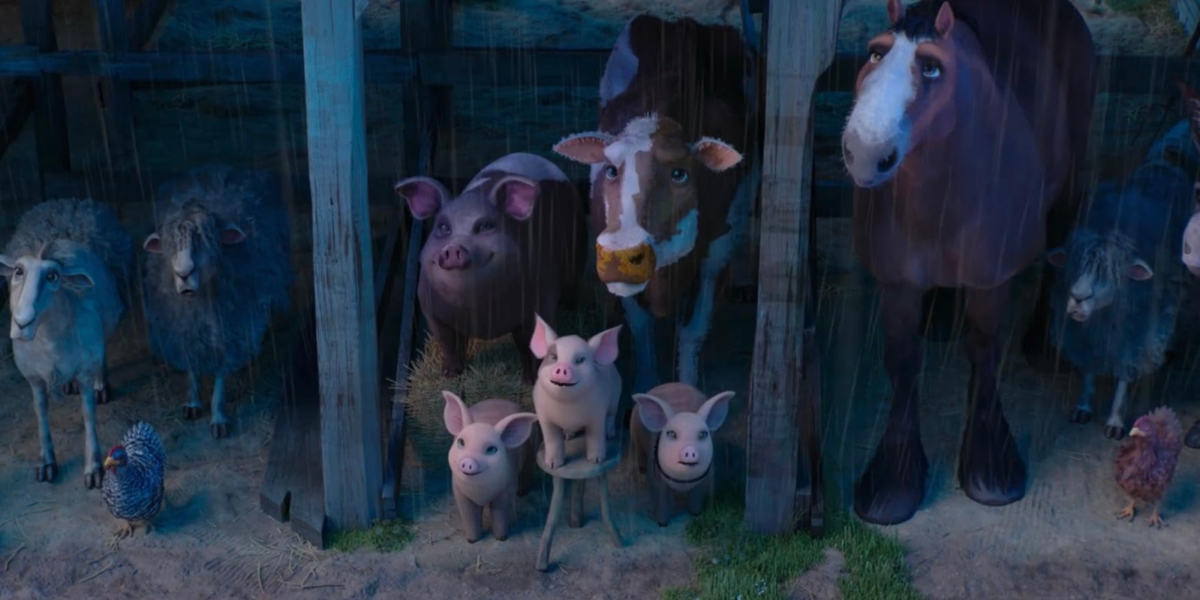













“Animal Farm” (2025), also titled “Animal Farm: A Cautionary Tail,” marks the third movie adaptation of George Orwell’s book of the same title. Originally screened at the 2025 Annecy International Film Festival, the movie has finally made its way to a mainstream theatrical release, premiering on May 1, 2026. Despite its circulation in film spaces for nearly a full year, viewers of the film, verified critic or not, show overall disappointment in “Animal Farm” (2025). The movie has a 21% on the Tomatometer, a scale used by Rotten Tomatoes, and a 2.1 star rating on social media platform Letterboxd.
To call this movie an adaptation of Orwell’s 1945 novella would be true, however to call it faithful or even innovative would be a gross understatement.
“Animal Farm” (2025) falls short on its plot quickly. The story begins in a different order of events and opens right as the animals begin to take over their farm. Within the first five minutes of the film, we learn explicitly that Lucky is the only other pig that knows how to read on this farm other than Snowball, the pig that taught him to read in the first place. We are also told by the narrator, Lucky from the future, that Napoleon is explicitly untrustworthy because the writers of this movie needed to spoonfeed viewers this information.
One of the most stark deviations from the “Animal Farm” novella in this movie is the addition of the character Lucky. Serving as a middleman between the conflicting interests of Snowball and Napoleon, his character effectively serves neither in the plot and feels more like a self-insert for the audience. Because of this, his character relies on the development of other characters, which you see none of because all of the major characters are personified stereotypes of societal caricatures (as in line with the original “Animal Farm”).
I feel that it is also important to mention, aside from the already important two legs bad, four legs good rules, and the overall disdain towards becoming human-like, you also have the words “no animal shall drink naughty juice” uttered verbatim. You also get Napoleon farting while declaring that this new life is freedom, to keep it on par with the comical childishness of this movie, and the writers of this film deliberating sacrificing plot for easy going humor and readability only destroys the meaning of the movie further.
After a scene where Lucky is offered milk meant to be shared with other animals, you get your first instance of conflicting interests between Lucky and Napoleon, as Napoleon wants to begin to encourage Lucky to be on his side because he can read. However Lucky quickly lets this idea go later in the story when he is brought into Napoleon’s wealthy elite group of pigs, showing that Lucky’s ideas aren’t all that much his own, and he seems to go with whatever benefits more until the tail-end of the film.
By this point in the story, you realize that even Napoleon’s interests completely switch, wherein the book the message is very clearly anti-authoritarianism, not capitalism. The pigs openly say they want to be like humans, make alliances with them and be respected by them. This is also when you hear the line “all animals are equal, but some animals are more equal than others,” effectively cementing that the pigs are now disconnected from the rest of the animals. To the pigs, authority comes from people because people run the world while animals do not.
At this point you are introduced to the other villains of the story, Frieda Pilkington and the Pilkington corporation, a company that seems to be an Amazon adjacent, with a gigantic company building with access to surveillance drones, a mega mall and thousands of offices contained within, once again showcasing comedic levels of overexaggerated capitalism because the viewers are assumed to be children that can otherwise not pick up on context clues. This name is clearly a nod to the rival farmer in the original story by the name of Pilkington, though now Pilkington is a placeholder for an evil capitalist character. Napoleon, as well as the rest of the pigs, go to shop at this mega shopping mall, which is also when the story introduces Puff as a character, a pointless romantic interest to Lucky that wasn’t mentioned in the story at all up until this moment.
Napoleon is now throwing lavish parties and inviting Freida Pilikington, and you’re starting to see the usage of “naughty juice” in the movie, which obviously is a placeholder for alcohol. Alcohol, being a forbidden beverage for the animals on the farm in the original rules, was a big component and driving force for corruption in the original Orwell novella, and now it is reduced to this seemingly inconsequential item, as the downsides of alcohol only showcase recklessness, rather than in the original story Napoleon sells an injured and weak Boxer to buy more whiskey.
In this new story, Napoleon acts as an absentminded drunk that drives sports cars into pools, rather than a wealthy, put together elite. It’s trashy, and you wonder if they were going to make an innuendo to alcohol in the first place, why didn’t they just call it alcohol? It’s not like the audience doesn’t already know what “naughty juice” implies. It’s a poor attempt at censorship that doesn’t even censor any ideas. Puff, the forced love interest of the story, tells Lucky that she doesn’t like how he is starting to act, agrees with everything Napoleon says and leaves the farm. Puff noticing the corruption in Napoleon is a very sudden plot device shoehorned in because up until now you learn absolutely nothing about her actual character other than she is a show pig.
Frieda Pilkington encourages Napoleon to create an alliance with her with the threat of the farm being bought out by her anyway, which Napoleon at first is against but ultimately agrees after he is promised more sports cars and unlimited food for the rest of the animals. Food, like the “naughty juice,” is handled weirdly in this story because in the book they are incentivised by things like grain and milk because they were animals. Because Napoleon already knows what money is, as well as the buying power of it, why would he be so incentivised by unlimited grain, when he already would know how little grain would cost to someone like Frieda, anyway? As a matter of fact, the rest of the animals know the value of money because they are already observing a wealth disparity within the farm, as they are living in the farm houses while the pigs are living in Mr. Jones’s upgraded house.
The climax of the film begins when Napoleon agrees to a large-scale industrialization of the farm, with many sleek modern excavators storming the premises and begin destroying everything. You also learn that Puff has never left the farm; she just had been living in the barn secretly teaching the other animals how to read. This information makes absolutely no sense because it was already established in the very beginning of the story that for a reason, only Snowball and Lucky knew how to read on the farm, but now this is now very accessible information. Why would there have been a separation of the pigs and other farm animals if not on the preconceived notion by Napoleon that only pigs knew how to read, if all the animals are capable of reading. To me, this feels like a lazy excuse to drive Napoleon to create this separation. The animals create a plan to foil Napoleon’s speech at the Pilkington stadium by rigging it with fireworks and screening a humiliating video of him falling over when he first tried to walk on two legs.
Then the movie follows a generic sequence of explosions with all of the animals escaping the building as a bunch of water towers begin to explode, flooding the entire area. For me this is also just a very lazy way to move the story, as there isn’t much screen time left and the climax needed something to remind watchers that this was still a kids movie in its heart. Napoleon realizes that Lucky made alliances with the farm animals to destroy his plan, which leads to a fight scene between the two pigs.
Lucky leaves the viewers with the message that not only Napoleon was wrong, but also Snowball was wrong too, and that they need to create a completely new system. This is one of the most insulting parts of this adaptation because it completely downplayed Snowball’s original plan and reduced it to effectiveness, when the operations of the farm were playing out just fine under her guidance. She advocated for a streamlined economy powered by electricity when she realized that the manual labor would be too slow. All Napoleon did was sell the surplus and take all the credit for every foundational document that Snowball had even proposed in the first place.
“Animal Farm” (2025)’s absurdity goes beyond the actual film itself. In the post credits scene, I couldn’t help but notice that there were QR codes on the side of the actual credits asking for what you think is viewer feedback. When you scan the QR codes, both lead you to make donations to Angel Studios to buy tickets for other families to see “Animal Farm.” However, scanning the QR code saying that you disliked the movie, titled “never do this again!” you are sent to a page that looks like it is run by Napoleon, telling you that you are wrong for not liking the movie. This post’s ironic disrespect towards the viewers also left a sour taste in my mouth, showing that these QR codes were only implemented to waste viewer time, but just like Napoleon, did not listen to the opinions of non-pigs on the farm which is our own capitalist society.
Beyond the film, the official @animalfarmthemovie Instagram page further disconnects the message of the movie, meme-ifying clips and even selling “Animal Farm” merchandise based on the new film. It is so obvious by this point that this movie exists as a publicity stunt, as not even the creators of this film take the campaigning of it seriously. It turns George Orwell’s story into a soulless corporate movie that doesn’t even resemble the plot of the novella.
My personal opinion on this film is that it could have been just a mediocre kids story if they didn’t feel like associating its namesake with the literary classic. I feel that the story of “Animal Farm” is very important to not misinterpret, especially in this current political climate. I feel like this movie has received much more hate than what the movie itself, separating it from the ideological message of the book, would warrant. To call this an adaptation of “Animal Farm” is downright distasteful, as I believe that if you were to change the names of the characters you wouldn’t be able to read this story as “Animal Farm” in the first place. Every character in the story is underdeveloped, shallow, or an obnoxious on the nose allegory that doesn’t even let viewers read into what these characters ideologically stand for. This adaptation exists for no reason. To say it plainly, “All “Animal Farm” adaptations are equal, but some “Animal Farm” adaptations are more equal than others.”
Will you be watching “Animal Farm” (2025)? Let us know in the comments!